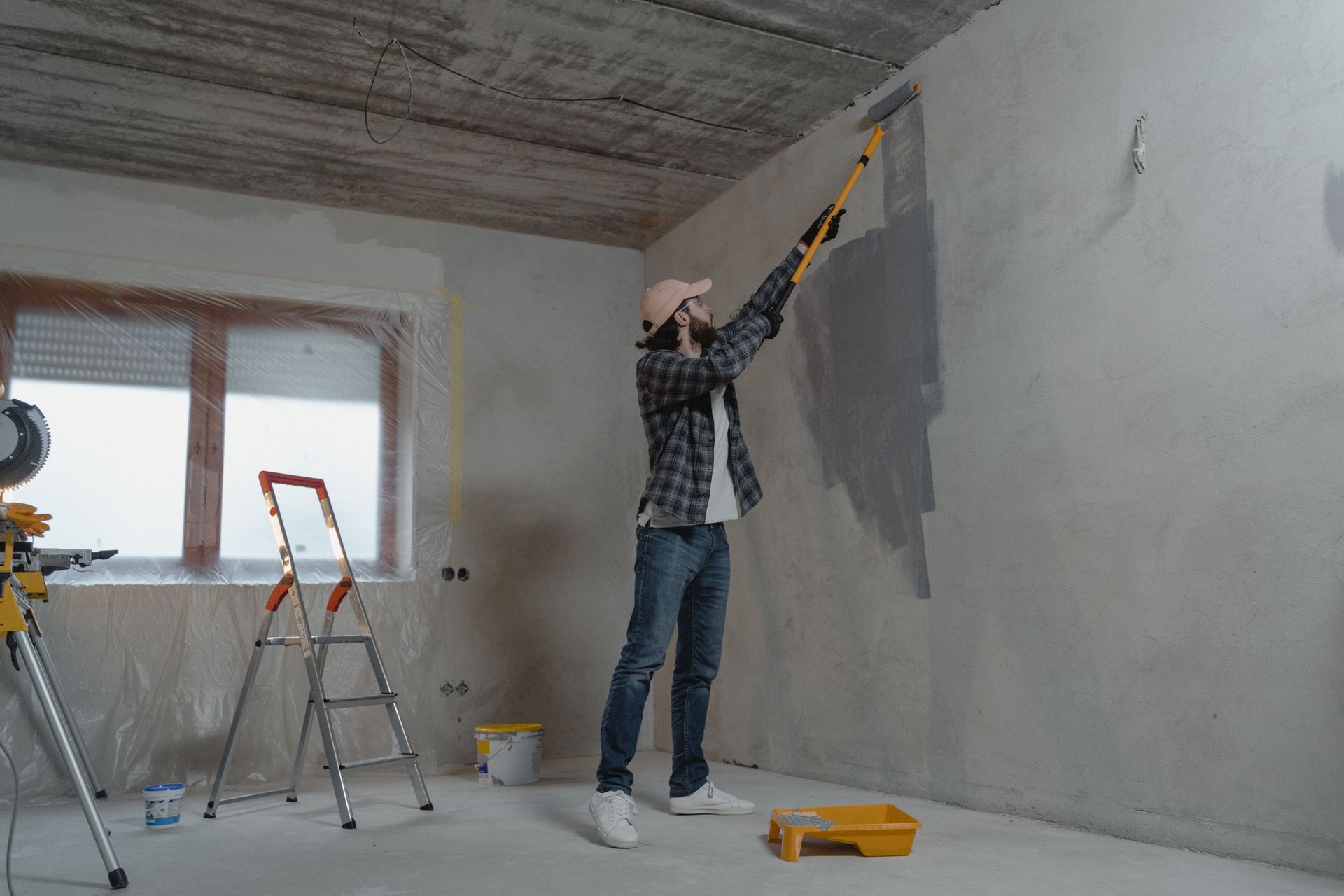
1. Prepare the visit and record decisions
Ask for the address, intended work, approximate dimensions, useful photographs and preferred timing before visiting. Photos help you prepare; they cannot establish the condition behind a concealed surface. Identify who selects finishes and who can approve the quote. Adapt your survey sheet to the trade: a decorator needs surfaces and protection; woodwork needs dimensions, faces to coat and protection for fittings.
Finish the visit with an action list. “Customer confirms paint reference by 15 October” is clearer than “paint to choose”. Record what is included, what still needs investigation and when you will follow up. Do not undertake an unsafe or intrusive inspection merely to fill an estimating worksheet.
2. Agree what the finished job includes
Agree which walls, ceilings and woodwork will be painted, and which items are excluded. Clarify the finish, colours, occupied rooms and protection. Repainting a sound wall differs from preparing damaged surfaces and painting the entire room. Confirm the expected result before applying a unit rate.
3. What painting contractors should record on site
Identify each visible substrate and record defects, previous repairs and access constraints. A damp mark needs an appropriate investigation of its cause; covering it does not resolve the underlying issue. If an old coating or substrate may present a hazard, arrange the relevant checks before sanding or disturbing it.
Separate protection, preparation, any primer and finishing. Select the process from the actual condition and manufacturer’s instructions. State the agreed products or characteristics and planned coats. A sound surface and one requiring substantial repairs should not automatically receive the same allowance.
Drying time is different from labour time, but it can require additional visits and affect room availability. Agree who moves furniture, removes fittings and provides access. Record cleaning and waste handling. These practical decisions explain why two painting quotes for the same apparent area may differ.
4. Capture quantities you can explain
Attach every measurement to a location and unit: wall area, skirting length or number of doors. Keep the calculation as well as the total. Separate the installed quantity from the purchase quantity; cuts and pack sizes depend on the chosen product and layout.
Record access, parking, working hours, furniture protection, waste removal and coordination with other trades. These details help you estimate the resources required. Photograph only useful details with the customer’s agreement and keep private documents out of the frame.
5. Calculate quantities and check units
Keep the original dimensions. A rectangular wall measuring 4 metres by 2.5 metres has a geometric area of 10 m². Subtracting a 0.9 by 2 metre opening gives 8.2 m². Explain the measurement convention in the proposal; this example is arithmetic, not a universal trade measurement rule. Returns, reveals and finishing may require separate work items.
The installed area is not necessarily the purchase quantity. Paint consumption depends on coats, the manufacturer’s coverage information and the substrate. Flooring orders depend on the layout, cuts and pack size. Use the chosen product’s technical information rather than a universal waste allowance. Convert all dimensions into compatible units before calculating and preserve enough precision to check the result later.
6. Build the cost before setting the selling price
Allow for materials, labour, travel, deliveries, equipment hire, waste handling and an appropriate share of business overheads. Your internal costing worksheet can be more detailed than the customer’s quote. A supplier invoice alone does not represent the cost of carrying out the whole job.
For a currency-neutral illustration, suppose materials cost 300 units, labour 200 and other allocated costs 100: total estimated cost is 600. Adding 20% of cost produces a selling price of 720. The difference of 120 is 16.67% of the selling price. To make the difference 20% of the selling price, calculate 600 ÷ 0.8 = 750. These figures exclude tax and do not establish net profit or recommend a market price.
Check what an extra half-day or delivery would do to your estimate. Copying another contractor’s unit price does not show whether your own business can perform the same scope at that price.
7. Write quote lines that can be checked
A useful line identifies the task, quantity, unit and price. Group work by room or trade package. Avoid a single “complete renovation” line when it hides what is included. Keep optional work separate from the accepted total until the customer chooses it.
Check product references, current supplier costs, availability and delivery before committing. State how long your proposal remains valid. The numbers in this guide illustrate the calculation only; they are not market rates or a pricing recommendation.
8. Turn dictation into a checked document
Dictate one block per task: location, work, material, quantity, unit, price and any qualification. State options and unresolved points separately. This is easier to review than a continuous account of the whole visit.
Vocalys lets you prepare quotes and invoices by voice. Before sending, check names, measurements, decimal places, line items, taxes and totals. Review the terms, timing and requirements that apply to your business. Your review remains part of the process.
9. Handle changes and learn from completed jobs
Keep the accepted version when a customer changes the specification. Identify the revised work, quantities, price effect and timing in a clearly labelled proposal. Obtain the agreement required for the particular contract and jurisdiction before treating additional work as approved. A vague qualification about unforeseen work does not explain how an actual change will be handled.
After completion, compare estimated and actual quantities, labour time and purchases. Record the reason for each material difference: an incomplete survey, a requested change, difficult installation or another delivery. Feed those observations into the next survey sheet. Your own records gradually provide more useful estimating evidence than a generic price list.
Tiler’s guide 2026: calculate quantities, cuts and waste for a clear quote
Fictional worked example
Australia : interior painting quote example
The survey covers 26 m² of walls. Specify the planned preparation, coats and included protection. Assess defects requiring specialist treatment separately.
Fictional calculation: 26 × $34.00, plus $90.00 for protection and cleaning, gives $974.00 before taxes. These are teaching figures, not market rates. Tax treatment depends on the job and business circumstances.
26 × $34.00 + $90.00 = $974.00
The Australian Government’s quoting guide lists useful written-quote information. Check the requirements for the relevant state or territory and the type of building work before issuing the final agreement. · Australian Government — Prepare quotes
Reusable job sheet
- Wall, ceiling and woodwork quantities by room
- Visible condition, repairs and unresolved checks
- Preparation, primer where required, products and coats
- Agreed colours, finish and product reference
- Furniture, protection, access, drying and return visits
- Cleaning, waste, exclusions, price and accepted version
Job: […]
Area and expected result: […]
Task / material: […]
Quantity and unit: […]
Unit price: […]
Included / excluded: […]
Confirm before committing: […]
Access and timing: […]
Reuse the same job sheet, then adapt it to your trade. Its purpose is to expose missing information before that information becomes a missing item in your quote.
FAQ
What should a painting contractor record before quoting?
Wall, ceiling and woodwork quantities by room ; Visible condition, repairs and unresolved checks ; Preparation, primer where required, products and coats ; Agreed colours, finish and product reference ; Furniture, protection, access, drying and return visits ; Cleaning, waste, exclusions, price and accepted version.
Can I send a dictated quote without reviewing it?
No. Dictation prepares a document, but you must check the customer, scope, quantities, prices, taxes, total and terms before sending it. Accurate transcription alone does not establish that the proposal fits the job.
Are the example prices recommended rates?
No. These fictional amounts demonstrate the calculation. Base your prices on your costs, work organisation, scope and job conditions. Check contractual and tax requirements separately for the actual jurisdiction.
Sources and references
Sources checked on .
- Australian Government — Prepare quotes · Australia
Requirements depend on the country, region, business status and contract. Check what applies before sending a document. These practical guides are not journalistic news.
This guide is published by Vocalys, the developer of the app featured here. Calls to action promote our own product. Our editorial approach